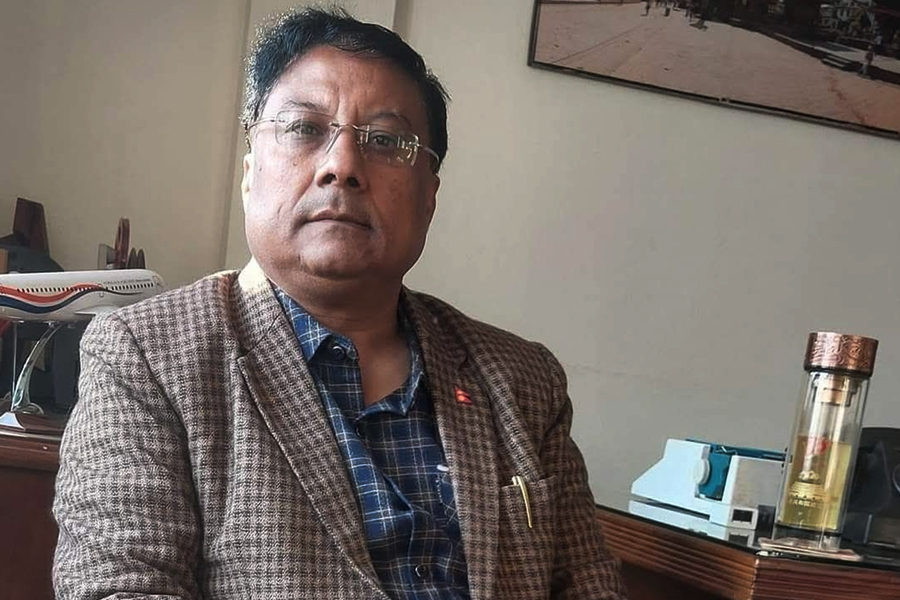
Journalist Kishore Shrestha has been arrested by police from his residence in Lalitpur on Wednesday evening.
13 August 2026 | Kathmandu, Lalitpur — Updated 22:30 GMT
Journalist Kishore Shrestha has been arrested by the police. A high-ranking police source has confirmed that the police arrested him from his residence in Lalitpur on Wednesday evening.
A team from the Valley Crime Investigation Office and the District Police Complex, Kathmandu was mobilized to arrest Shrestha. According to the police, he was arrested for investigation on charges of violating the Personal Privacy Act, 2075 BS. He is the editor of Jana Aastha Weekly.
SSP Dilip Ghimire of the District Police Complex, Kathmandu said that a victim had filed a complaint against Shrestha. 'The matter is related to his photo that appeared in the media a few days ago,' he told among journalists, 'so far only one complaint has been received.'
He is currently being held in custody at the District Police Complex, Kathmandu. Preparations are underway to produce him in court tomorrow (Thursday).
Welcome to the latest news — where press freedom, privacy laws, and investigative journalism collide in Nepal's media landscape.
📰 NEPAL NEWS — KEY FACTS: Journalist Kishore Shrestha arrested • Personal Privacy Act, 2075 BS invoked • Complaint filed by Saptari 3 MP Amar Kant Chaudhary • Deputy Speaker Ruby Kumari Thakur files complaint with Press Council • Prachanda demands immediate release • Federation of Nepali Journalists stages sit-in protest • Jana Aastha Weekly founded 2048 BS (1992 AD).
Police Arrest Jana Aastha Editor Over Privacy Violation Complaint
Journalist Kishore Shrestha has been arrested by the police. A high-ranking police source has confirmed that the police arrested him from his residence in Lalitpur on Wednesday evening.
A team from the Valley Crime Investigation Office and the District Police Complex, Kathmandu was mobilized to arrest Shrestha. According to the police, he was arrested for investigation on charges of violating the Personal Privacy Act, 2075 BS. He is the editor of Jana Aastha Weekly.
He is currently being held in custody at the District Police Complex, Kathmandu. Preparations are underway to bring him in court tomorrow (Thursday).
A few days ago, Shrestha had made public a picture of a young woman with MP Chaudhary.
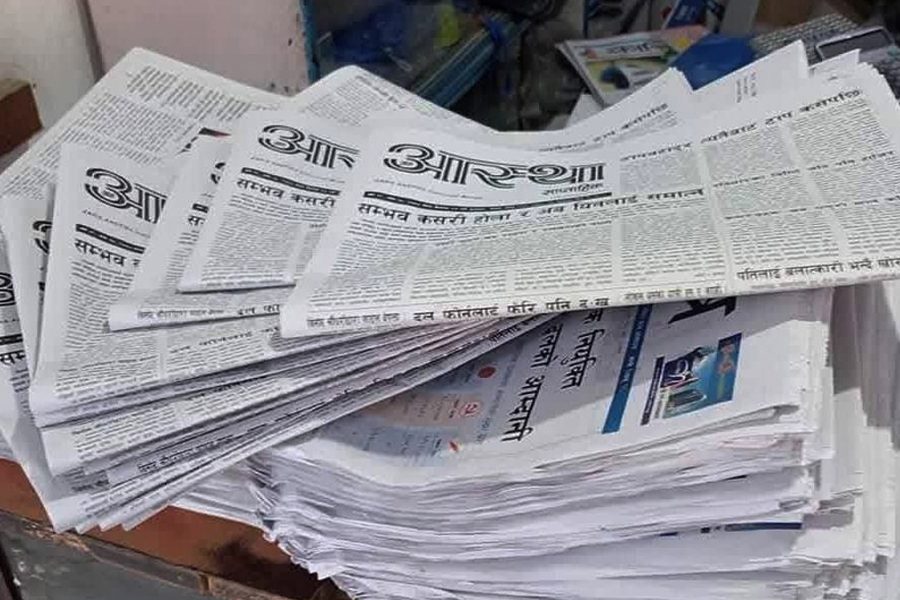
Jana Aastha Weekly, a legendary Nepali investigative newspaper founded in 2048 BS (1992 AD).
Prachanda Demands Immediate Release of Journalist Shrestha
Nepalese Communist Party coordinator Pushpa Kamal Dahal 'Prachanda' has demanded the immediate release of Janaastha Weekly editor Kishor Shrestha.
Prachanda has objected, saying that "the arrest by the state without adopting certain methods and procedures on the basis of writing news is a mockery of democracy."
— Pushpa Kamal Dahal 'Prachanda', Nepalese Communist Party Coordinator
He stressed the need to respect the freedom of the press and expression and follow the legal process.
Prachanda has said that the arrest of Shrestha by the state without following certain methods and procedures on the basis of writing a news story is a mockery of democracy.
He has also demanded Shrestha's immediate release.
Prachanda has objected to the incident of Shrestha being arrested and detained by the state on a matter related to news publication. He stressed the need to respect the freedom of the press and expression and follow the legal process.
Federation of Nepali Journalists Warns of Strong Agitation Over Arrest
The Nepali Journalists Federation has warned of strong agitation against the arrest of journalist Kishore Shrestha.
Journalists and media workers, including Federation President Nirmala Sharma, have staged a sit-in in front of the Kathmandu Police Complex to express their objection to Shrestha's arrest.
During the sit-in, the Federation has demanded that the concerned body immediately make a clear statement on the arrest of journalist Shrestha.
— Nirmala Sharma, Federation of Nepali Journalists President
Federation President Nirmala Sharma has warned that interference with the freedom of journalists and press freedom is unacceptable and that the Federation will launch a more vigorous protest if the problem is not resolved immediately.
The Federation has demanded that the reason for the journalist's arrest be made public, the legal process be made transparent, and the constitutional rights of journalists be respected.
Official details about the charges against journalist Shrestha and the legal basis for the arrest are yet to be made public by the concerned body.
The Federation has stated that it will launch a phased protest if its demands are not addressed.
Deputy Speaker Ruby Kumari Thakur Files Complaint With Press Council
Deputy Speaker Ruby Kumari Thakur also filed a complaint with the Press Council Nepal today, alleging that objectionable and threatening material including her photo was published on the social media page of Janaastha.com. Her complaint demanded a fair investigation by citing the sources and evidence of the allegations and claims mentioned in the material.
Jana Aastha Weekly: From Palace 'Gossip' to Investigative Journalism
Jana Aastha, which was born as a rebellion from a party mouthpiece, has succeeded in establishing an identity of investigative and anonymous, i.e. source-based journalism from the very beginning. On the one hand, it has created an image of 'fearless investigative journalism', while on the other hand, it has also been accused of 'sensationalizing beyond the boundaries of journalism'.
After the report of the inquiry commission formed on the 'Gen-G movement' that the government tried to keep secret was made public, many questions and debates began about it. Along with this, 'Jana Aastha Weekly', which made the secret report public, also came into the news.
Despite the demand to make the report public from the streets and social media, in the backdrop of the government's hesitation, Jana Aastha has brought its old image of 'breaking confidential information' and style of not being afraid of the government back into the debate. However, this practice of 'clashing with the government' is not the first for Jana Aastha. Because the rise of this magazine was not ordinary, it was the product of institutional rebellion.
📰 JANA AASTHA WEEKLY — KEY MILESTONES
- Founded: 24 February 2048 BS (1992 AD)
- Founder: Kishore Shrestha and team
- Initial investment: Rs 250,000 from 5 supporters
- Origin: Rebellion from UML mouthpiece 'Drishti'
- Key exposures: Namita-Sunita murder case, Achham massacre, Krishna Sen murder, Palace leaks
- Threats faced: Military censorship, death threats, office raids
- Notable alumni: Sudhir Sharma, Gunaraj Luintel, Rajaram Gautam, Arun Baral, Sitaram Baral
The Birth of Jana Aastha: Rebellion Against Party Control
At that time, when the dominance of the Panchayat and the new ray of multi-party politics were waiting, weekly magazines were considered the mainstream of the media world. Especially after the political changes of 2046 BS and before the emergence of large daily newspapers, weekly magazines played the main role in informing Nepali society and politics.
The famous weekly at that time was 'Drishti'. Which was run as mission journalism. Its public identity was the mouthpiece of the then UML. At that time, 'Drishti' was printed up to 49/50 thousand copies weekly. Journalist Kishor Shrestha used to write in that weekly.
Despite being considered famous, disputes arose between Shrestha's team and the then UML party leadership on issues such as ownership of journalists in the news, freedom of writing, and imposing editors from outside. In a public interview on the 'New Page' online portal, journalist Shrestha has revealed about his confrontation with the then UML leader Bamdev Gautam.
Shreshtha has told in an interview that Gautam refused when he demanded that the newspaper be institutionalized and taken under his ownership. After listening to Gautam, Shrestha and his team left empty-handed. Apart from Shambhu Shrestha and Agnishikha, the publishers of 'Drishti', most of the management and editorial staff joined Jana Aastha with Kishor Shrestha. These included Khagendra Thapa Magar, Harish Phuyal, and Bhikshu Ashwaghosh.
In this way, Kishor Shrestha says that Jana Aastha was born with the aim of doing independent and critical journalism outside the control of the party. The interesting thing was that since 'Drishti' was also going to be published on Wednesday, Jana Aastha also chose Wednesday as the publication day.
— Kishore Shrestha, Editor, Jana Aastha Weekly
The Namita-Sunita Murder Case: A Defining Moment
The mysterious murder case that was tried to be hidden at that time is the 'Namita-Sunita murder case'. The mysterious murder and disappearance of Namita and Sunita Bhandari of Kathmandu and their relative Nira Parajuli, who were on a visit to Pokhara on 18th Jestha 2038 BS, is considered one of the most gruesome and politically suppressed incidents in the history of Nepal.
The bodies of Namita and Sunita, who were among those who had gone to visit Begnas Lake on 24th Jestha, were found on the banks of the Seti River, having been raped and murdered, while the condition of Nira is still unknown. In this case, which is suspected to involve the then Panchayat regime and high-ranking officials of the royal court, it is alleged that the police investigation was influenced by the power center, the autopsy report was manipulated, and even the forest guard Chudamani Adhikari, who was said to be an eyewitness to the incident, was detained and disappeared.
Kishor Shrestha had exposed the incident through a 6-month long investigative reporting in the weekly 'Drishti' in 2048 BS, which he later presented in detail in a book titled 'Another Murder Suppressed After the Court Case'.
Threats, Censorship and Persecution
Arun Baral, who once worked for Jana Aastha and is now the editor-in-chief of 'JasNepal' Online, recalls, 'During our time, news from the palace used to break every week. From the personal lives of members of the royal family to their innermost affairs, Jana Aastha has faced threats at various times for making such palace information and confidential information public.'
'The then Crown Prince Paras and Army Chief Prajwal Shamsher had directly threatened to 'shoot' or kill me,' Shrestha said. 'Prabhas Shamsher, son of Prajwal Shamsher, was looking for me with two pistols.'
Shrestha was arrested from his office on Magh 16 (Martyr's Day) for writing about the Achham incident. He also recounted the incident in which a 21-member military team led by a colonel stayed at the Jana Aastha office for three weeks and censored every word of the newspaper after the royal move of Magh 19, 2008.
— Arun Baral, Former Jana Aastha Journalist
Arun Baral was a witness at that time. 'When the incident of Magh 19 took place, the army's team came and sat in the office of Jana Aastha. The team led by the general tried to control it by saying, 'This is allowed to be printed, this is not allowed',' Arun Baral recalls. 'When the army tried to ban the materials, editor Kishor Shrestha directly protested along with the army general. Even when the army threatened to take him away and other employees were scared, he did not waver. Jana Aastha had published cartoons and some critical content.'
Controversies and Criticism
However, Janaastha's journey was not always unchallenged. On the one hand, its image is that of 'fearless investigative journalism', while on the other hand, accusations of 'overstepping the boundaries of sensationalism' have also been made.
One of the sensational incidents that crossed the boundaries of Janaastha's journalistic values is the suicide of artist Shrisha Karki. On Wednesday, Asoj 23, 2059 BS, Janaastha Weekly published a story on its 'Front Page' titled 'The Colorful Night of the Film City'. The material, written by the journalist duo Bishwamani Subedi and Yadav Prasad Pandey of Janaastha, was written as if it was an investigation into the 'love affairs' etc. that are taking place in the Nepali film industry.
The Rise of Journalists
Amidst praise and criticism, Janaastha has also lift up many journalists. There was a large presence of ideological and intellectual figures in the initial journey of Janaastha. The involvement of the late Kamal Koirala, the late Ramesh Bikal, the late Prem Singh Dhami, the late Bhikshu Ashwaghosh and the late Suresh Manandhar is considered to have established it not only as a source of information, but also as an intellectual platform.
Similarly, personalities like Pradeep Nepal who were involved in politics and journalism further expanded its effectiveness. Their guidance and the aggressive news style of Janaastha always inspired journalists to reach the innermost level of facts. If we look at today's Nepali mainstream journalism, the presence of 'products' of Janaastha is visible in it.
The professional foundation of former editor-in-chief of Kantipur Sudhir Sharma and editor-in-chief of Nagarik Dainik Gunaraj Luintel to former editor-in-chief of Annapurna Post Rajaram Gautam began here. Arun Baral (currently editor-in-chief of JasNepal), who was once the editor of online news, and journalists like Sitaram Baral, Matrika Poudel, Parashuram Kafle, Sitaram Bhattarai, Chudamani Bhattarai, Tikaram Rai, Binod Dhungel, Madhav Dhungel have also advanced in journalism through the 'schooling' of Janaastha.
📰 NEPAL NEWS: THE NUMBERS THAT DEFINE THE MOMENT
🚨 ARREST AT A GLANCE
Journalist arrested
Complaint filed (MP)
BS Personal Privacy Act
Press Council complaint (Deputy Speaker)
🗣️ KEY VOICES
SSP Dilip Ghimire (Police):
"The matter is related to his photo that appeared in the media a few days ago."
Pushpa Kamal Dahal 'Prachanda':
"The arrest is a mockery of democracy."
Nirmala Sharma (FNJ):
"Interference with press freedom is unacceptable."
📰 JANA AASTHA MILESTONES
⚠️ MAJOR EXPOSURES & CONTROVERSIES
🔴 THREATS & PERSECUTION
📰 THE FINAL VERDICT: PRESS FREEDOM, PRIVACY, AND INVESTIGATIVE JOURNALISM
✅ WHAT'S HAPPENING:
- Journalist Kishore Shrestha arrested under Privacy Act
- Complaint filed by MP Amar Kant Chaudhary
- Deputy Speaker Ruby Kumari Thakur files Press Council complaint
- Prachanda demands immediate release
- FNJ stages sit-in protest, warns of agitation
⚠️ THE CHALLENGES:
- Press freedom vs. privacy rights debate
- Jana Aastha's legacy of fearless investigative journalism
- History of state persecution and censorship
- Accusations of sensationalism
- Legal process transparency questioned
"The arrest of Kishor Shrestha by the state without following certain methods and procedures on the basis of writing a news story is a mockery of democracy," Prachanda declared, as Nepal's veteran investigative journalist was arrested under the Personal Privacy Act. The Federation of Nepali Journalists staged a sit-in protest, warning of strong agitation. Shrestha's Jana Aastha Weekly has a 34-year legacy of fearless investigative journalism, exposing palace secrets, political scandals, and state atrocities — but also facing accusations of sensationalism, censorship, and death threats.
— News Analysis
Stay updated with the latest news, world headlines, and breaking developments on our World News Page.