Putin's Strategic Gambit: Russia's Bold Alliances with North Korea and Vietnam Challenge Global Dynamics — A New Axis Emerges
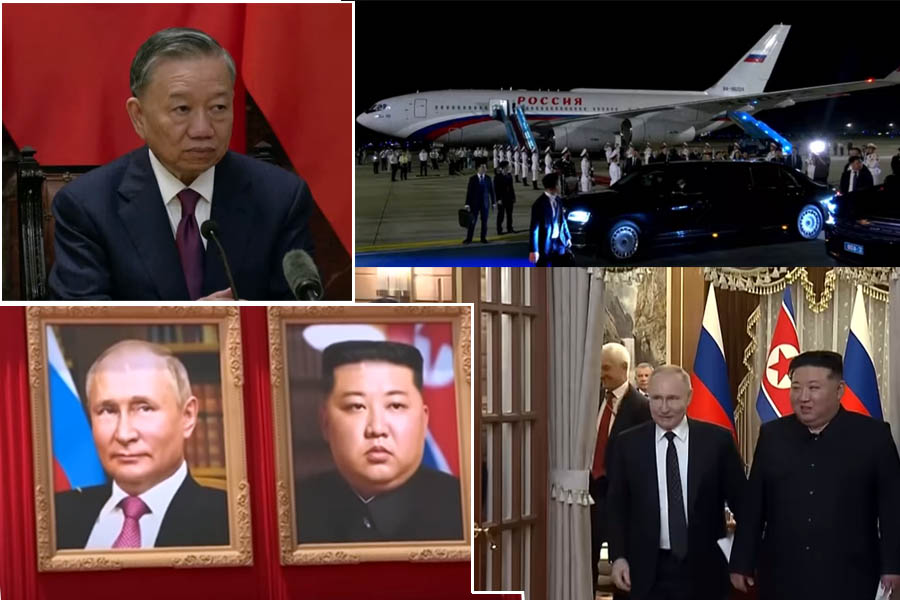
In a historic move that's shaking the foundations of global diplomacy, Russian President Vladimir Putin recently visited Pyongyang, signaling a significant shift in international alliances. This landmark visit, the first of its kind in 24 years, has seen Putin and North Korean leader Kim Jong-un delve into deep discussions, reportedly sharing "pent-up inmost thoughts." Amidst widespread international condemnation following Russia's actions in Ukraine, this burgeoning partnership promises to reshape the geopolitical landscape, creating a new axis of aligned powers that challenge Western hegemony.
The two leaders discussed enhancing economic and security cooperation, with potential agreements hinting at strategic military partnerships. This alliance, while controversial, showcases both nations' intent to stand resilient against global pressures. Analysts predict that this visit will lead to strengthened economic ties and possibly military collaborations, adding a new dimension to their relationship. This alliance is a testament to their determination to navigate through diplomatic isolation, fostering a united front in the face of international scrutiny.
🇰🇵 Pyongyang Summit: A New Chapter in Russia-North Korea Relations
During the summit, Putin and Kim signed a "comprehensive strategic partnership" treaty that includes a mutual defense clause — a significant escalation from previous agreements. Under the terms, each party agrees to provide military assistance "without delay" if the other is invaded. While framed as defensive, the agreement raises alarms in Washington and Seoul, given North Korea's aggressive posture and Russia's ongoing war in Ukraine.
The summit also reportedly included discussions of weapons transfers. Western intelligence has long alleged that North Korea has supplied Russia with artillery shells and ballistic missiles for use in Ukraine, a claim both countries deny. In return, analysts believe Russia may provide North Korea with advanced missile technology, satellite capabilities, and nuclear submarine technology — a nightmare scenario for US Pacific Command.
"This is not just a diplomatic gesture," said Dr. Andrei Lankov, a North Korea expert at Kookmin University. "This is a genuine strategic alignment between two pariah states that share a common enemy: the United States and its allies. The implications for East Asian security are profound."
🇻🇳 Controversy in Vietnam: Putin's Red Carpet Welcome
Following his pivotal visit to North Korea, President Putin's arrival in Vietnam has sparked significant controversy, particularly from the United States, Vietnam's principal trade partner. The Vietnamese leadership, led by President To Lam, greeted Putin with a red carpet, underscoring their historical ties and mutual interests dating back to the Soviet era. Photos of Putin shaking hands with To Lam, standing beneath a Vietnamese flag, were broadcast worldwide — a powerful image of defiance toward Western attempts to isolate Russia.
Putin's discussions in Vietnam are centered around bolstering economic, educational, and energy cooperation, with defense issues and the Ukraine conflict also likely topics of private talks. Despite Vietnam's neutral stance on the Ukraine conflict — Hanoi has abstained from UN votes condemning Russia — the U.S. has condemned the visit, emphasizing that no nation should offer Putin a platform amidst the ongoing conflict. The State Department issued a statement expressing concern that "any nation hosting Putin gives legitimacy to his aggression."
This visit highlights Vietnam's delicate diplomatic balancing act. Historically aligned with Russia, especially during the Vietnam War era when the Soviet Union was a key ally against the United States, Vietnam continues to maintain strong ties, evident in its use of Russian military equipment — including submarines, fighter jets, and surface-to-air missiles — and partnerships in oil exploration in the South China Sea. However, Vietnam also values its trade relationships with China, the United States, and Europe, necessitating a careful diplomatic approach to appease all sides.
Vietnam's warm reception of Putin, while significant, also reflects its strategic diplomacy, ensuring it remains a friend to all amidst a complex global terrain. Washington's rebuke underscores the tensions, but Vietnam's historical loyalty to Russia and its current geopolitical strategies ensure a nuanced diplomatic stance. For Hanoi, hosting Putin is a calculated risk — a signal to Beijing and Washington that Vietnam has options.
🚁 The Drone War: Ukraine vs. Russia's Electronic Warfare
In the technological battleground of modern warfare, Ukraine is rapidly advancing its drone capabilities to counter Russia's sophisticated electronic warfare tactics. Ukraine's ISR Defence has upgraded its drones with advanced components to withstand and counteract Russian jamming signals. This evolution signifies the critical role of drones in contemporary conflicts, where both nations are in a relentless race to outdo each other in electronic warfare.
Ukraine's enhancements aim to make its drones more autonomous and resilient, incorporating artificial intelligence to identify targets even when GPS and radio signals are jammed. The "electronic warfare bubble" that Russian forces have created along the front lines has been a major challenge for Ukrainian drone operators, but new frequency-hopping technology and fiber-optic controlled drones are helping to overcome these defenses. This high-stakes duel has drawn significant attention from Western observers, highlighting the intense and ever-evolving nature of modern warfare.
According to Ukrainian commanders, the drone war has become the central feature of the battlefield, with thousands of FPV (first-person view) drones launched daily by both sides. "Whoever masters the electromagnetic spectrum will win this war," said a Ukrainian drone operator. "It's that simple." Russia, for its part, has invested heavily in electronic warfare systems like the R-330Zh Zhitel and the Krasukha-4, which can jam drones from kilometers away. The technological arms race shows no signs of slowing.
🇺🇸 Biden's Dual Challenge: Green Energy and China
President Joe Biden faces a complex dilemma as he balances his administration's push for renewable energy with a tough stance on China. To protect American industries, the administration has imposed barriers on Chinese clean-energy imports, including solar panels and batteries. These measures aim to safeguard American jobs but risk slowing the growth of the renewable energy sector, creating a tension between climate goals and economic nationalism.
Recently, the reintroduction of duties on China-based solar panel manufacturers and the backing of an antidumping petition by the International Trade Commission have further complicated matters. As the presidential election approaches, Biden's challenge lies in maintaining this delicate balance, ensuring the growth of green energy while protecting domestic industries. The administration has also announced $2 billion in grants to domestic battery manufacturers as part of the Inflation Reduction Act, attempting to build a US supply chain independent of China.
Critics argue that the tariffs will raise costs for American consumers and slow the transition to renewable energy, while supporters say they are necessary to prevent China from dominating the global green energy market. "We cannot repeat the mistakes of the solar industry," a Commerce Department official said, referring to China's capture of 80% of global solar panel production. "Green energy must be made in America."
⚓ Geopolitical Tensions: The Cuba-Russia Connection
Amid escalating global tensions, Cuba's strengthening ties with Russia have raised alarms in the United States. A recent visit by a fleet of Russian warships, including a nuclear-powered submarine and a frigate, to Havana has drawn significant attention. These vessels, armed with advanced weaponry, including hypersonic missiles, engaged in military drills just 90 miles from Florida, showcasing a display of military cooperation that supports Cuba's communist government and its ally, Venezuela.
While the U.S. monitors the situation closely, Cuba's foreign ministry has assured that the vessels were not armed with nuclear weapons, despite Russia confirming the presence of hypersonic missiles. The deployment is widely seen as a symbolic show of force, reminiscent of the Cold War when Soviet ships regularly visited Cuban ports. The timing — during heightened tensions over Ukraine — is no coincidence.
This visit underscores the deepening alliance between Cuba and Russia, echoing Cold War tensions and highlighting the complex dynamics of modern geopolitics. The U.S. has responded by deploying its own naval assets to the region and increasing surveillance flights. "We are not in a new Cuban Missile Crisis," a Pentagon official said, "but we are watching very carefully."
🌍 A World at a Crossroads
In a dramatic culmination of escalating geopolitical maneuvers, Russian President Vladimir Putin's historic visits to North Korea and Vietnam have set the stage for a significant realignment of international alliances. His unprecedented trip to Pyongyang, where he shared deeply personal discussions with Kim Jong-un, marked the beginning of a strategic partnership poised to reshape global power dynamics. This move was swiftly followed by a controversial visit to Vietnam, met with a red carpet welcome from President To Lam, despite sharp rebukes from the United States.
Concurrently, Ukraine's advancements in drone technology to counter Russian electronic warfare signal a relentless technological arms race, while Cuba's fortified ties with Russia, exemplified by the docking of a Russian nuclear-powered submarine in Havana, echo Cold War-era tensions, showcasing a world teetering on the edge of a new geopolitical order. The emerging axis of Russia, North Korea, China, Iran, and aligned states represents the most significant challenge to the US-led international order since the end of the Cold War.
As the world watches, the question remains: will this new alignment lead to a more multipolar — and more stable — global system, or will it increase the risk of miscalculation and conflict? The answer will depend on the choices made in Washington, Beijing, Moscow, and other capitals in the coming months. One thing is certain: the post-Cold War era is over. A new one has begun.
Related Coverage: For more on Russia's global strategy, visit Russia-Ukraine Conflict Intensifies in Sumy and Kharkiv and Putin's Visit to China: Deepening Russia-China Ties.
Global Post Headline — independent coverage of global geopolitics and international relations. globalpostheadline.com | Follow updates: Russia News | Politics

Experience the Himalayas with expert Sherpa guides. Trekking, expeditions, and cultural tours in Nepal, Tibet & Bhutan.
Plan Your Nepal Trip →
Authentic Nepali crafts, pashmina, singing bowls — worldwide shipping.