1 September 2026 | Kyiv, Ukraine — Updated 12:00 GMT
Russia has intensified its aerial campaign against Ukraine, launching hundreds of faster jet-powered drones during a sustained wave of attacks that has forced Kyiv residents to endure repeated daytime air-raid warnings.
Ukrainian President Volodymyr Zelenskyy said almost 1,500 drones of different types had been launched against Ukraine over a four-day period, including about 800 jet-powered drones. The newer weapons are significantly faster than older piston-engine Shahed-type drones, creating a fresh challenge for Ukraine's low-cost interceptor systems.
The escalation comes as the diplomatic and economic fronts remain active. US Treasury Secretary Scott Bessent told Russian Finance Minister Anton Siluanov that economic relief or agreements on other issues were not possible until the war ended, according to a source familiar with their meeting at the G20 finance gathering in Asheville, North Carolina.
Welcome to the latest world headlines — where ballistic missile development, record-breaking drone attacks, and the escalating air war collide across Ukraine and Russia.
About 800 jet-powered drones reportedly launched in four days • Almost 1,500 drones of all types • New jet-powered models reported at around 200–250 mph • Prolonged daytime air alerts in Kyiv • Ukraine developing faster interceptor drones • Washington says economic relief for Russia depends on an end to the war.
Kyiv Faces a New Wave of Daytime Drone Attacks
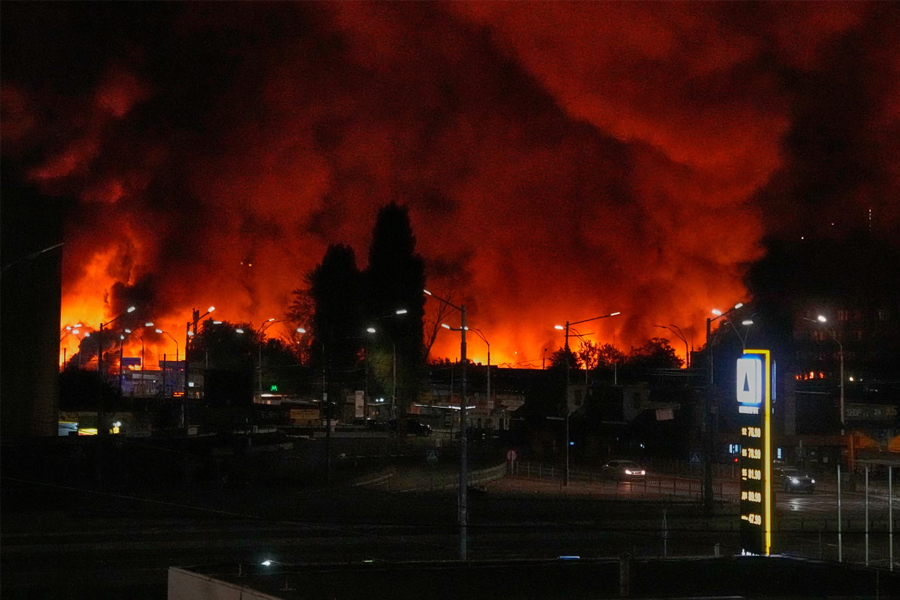
Kyiv has endured repeated waves of Russian drone attacks, with air-raid warnings continuing for hours during daylight. The change is significant because large-scale daytime drone attacks have historically been less common than overnight barrages.
The latest attacks have disrupted daily life across the capital and surrounding areas. Residents have been repeatedly forced to seek shelter, while emergency crews face the added danger of having to suspend rescue and firefighting operations when another wave of drones approaches.
Reports from Ukrainian authorities said the latest attacks killed four people and injured more than a dozen others in Kyiv and the surrounding region. Local officials also reported damage to residential and commercial infrastructure.
Odesa and other Ukrainian cities were also targeted as Russia continued a broad aerial campaign involving drones and missiles.
Air Alerts Are Becoming Part of Daily Life
Kyiv residents have increasingly had to plan their working day around air-raid warnings. Repeated alerts can also create significant pressure on businesses, public transport, schools and emergency services.
Ukrainian authorities have urged residents to follow official warnings and avoid spreading unverified information about individual strikes or casualties.
About 800 Jet-Powered Drones Launched in Four Days
Zelenskyy said Russia had launched almost 1,500 drones of all types against Ukraine over four days, with approximately 800 of them powered by jet engines.
The figures underline the scale of Russia's current drone campaign and the growing importance of faster unmanned weapons on the battlefield.
Ukrainian officials have warned that the increasing proportion of high-speed drones is changing the economics of air defence. Systems designed to counter slower drones may have less time to detect, track and engage faster targets.
Why Jet-Powered Shaheds Are Harder to Intercept
Earlier Shahed-type drones used piston engines and propellers and typically travelled at relatively low speeds. Newer jet-powered variants are considerably faster.
Reports put the cruising speed of some of the new models at approximately 200 to 250 mph, compared with around 115 mph for earlier piston-powered versions.
That difference gives Ukrainian defenders less time to respond and can reduce the effectiveness of inexpensive interceptor drones that were developed specifically to hunt slower targets.
The new weapons also allow Russia to combine high numbers with greater speed, forcing Ukraine to constantly adapt its detection and interception network.
Geran-4 Emerges as a Major Concern
One of the newer jet-powered models identified in reporting is the Geran-4, part of Russia's expanding family of Shahed-derived attack drones.
A Geran-4 reportedly struck an ammunition storage site near Myla, west of Kyiv, triggering secondary explosions and causing a large number of casualties, according to reports cited in the supplied material.
Such incidents demonstrate the danger posed not only by the initial drone strike but also by secondary explosions when weapons or ammunition are stored at the target site.
Russia Is Expanding Jet-Drone Production
Russia has increasingly manufactured Shahed-derived drones domestically after receiving technology associated with Iranian-designed systems.
The jet-powered Shahed-238 was publicly unveiled by Iran in 2023. Russia subsequently developed and produced its own variants, including drones identified in reporting as Geran-3 and Geran-4.
Ukrainian defence adviser Serhii Beskrestnov said at least 2,500 jet-powered drones had been launched against Ukraine during August, compared with about 1,500 during the previous month.
If sustained, that production and deployment rate would represent a significant challenge for Ukraine because air defence must continuously replace interceptors while defending a large territory.
📊 THE JET-DRONE THREAT — KEY FIGURES
- 800: Jet-powered drones reportedly launched during a four-day period.
- 1,500: Drones of all types reportedly launched during the same four days.
- 200–250 mph: Reported cruising speed of newer jet-powered models.
- 115 mph: Approximate speed reported for earlier piston-engine models.
- 2,500: Jet-powered drones Ukrainian officials said were launched during August.
- 1,500: Approximate number reportedly launched during the previous month.
Ukraine Races to Develop Faster Interceptor Drones
Ukraine has responded by developing relatively inexpensive interceptor drones intended to destroy incoming Shahed-type weapons before they reach their targets.
These systems are particularly important because using expensive surface-to-air missiles against every low-cost attack drone can quickly become economically unsustainable.
But the arrival of faster jet-powered weapons is forcing Ukrainian engineers to redesign the defensive approach once again.
Zelenskyy said several Ukrainian companies were developing interceptor drones capable of engaging the newer high-speed targets.
The contest is therefore becoming a race between attack speed, production capacity, interception cost and defensive endurance .
Drone Warfare Is Also Hitting Supply Chains
Russia's campaign has increasingly extended beyond military positions to warehouses, logistics centres and other infrastructure supporting Ukraine's economy.
Attacks on distribution facilities around Kyiv have contributed to concerns about shortages and disrupted supply chains.
Ukrainian officials have urged consumers not to panic, saying companies are rebuilding damaged distribution networks and working to maintain supplies.
The concern is particularly sensitive as Ukraine approaches another winter, when energy infrastructure, transportation networks and food distribution systems are already under significant pressure.
US Keeps Economic Pressure on Moscow
The military escalation coincides with continued economic pressure on Russia.
Bessent met Siluanov on the sidelines of the G20 finance leaders' meeting in Asheville. The appearance by Russia's finance minister was notable because it was his first in-person attendance at the forum since Russia's full-scale invasion of Ukraine.
According to a person familiar with the meeting, Bessent made clear that economic relief and agreements on other issues would not be possible until the war ended.
European officials reacted negatively to Russia's participation, while European governments continued to discuss additional sanctions and measures aimed at limiting Moscow's ability to evade restrictions.
Modi Tells Putin the Ukraine War Must End
Diplomacy remained active elsewhere as Indian Prime Minister Narendra Modi met Russian President Vladimir Putin in Bishkek, Kyrgyzstan, on the sidelines of the Shanghai Cooperation Organization summit.
Modi told Putin that the war needed to end and called for a transition from continued fighting toward a cessation of hostilities.
India has maintained close economic relations with Russia throughout the war and remains a major buyer of Russian oil. New Delhi has nevertheless repeatedly called for dialogue and a negotiated settlement.
Putin responded by saying Russia was moving along the path toward peace, although Moscow continues to demand conditions that Ukraine has rejected.
NATO and European Security Concerns Grow
The drone war is also generating security concerns outside Ukraine.
NATO fighter aircraft were scrambled following an air-threat warning near Latvia's border with Russia, according to reporting cited in the supplied material.
Russia has also reported drone threats around Moscow and other regions, while Ukrainian attacks have increasingly reached targets deep inside Russian territory.
These developments demonstrate how drone warfare is expanding the geographical reach of the conflict and increasing the risk of incidents involving neighbouring NATO states.
Ukraine Seeks Stronger International Pressure on Russia
Kyiv is simultaneously pressing Washington and European governments for additional sanctions against Moscow.
Ukraine's sanctions officials are lobbying US lawmakers to advance legislation that could impose further restrictions on Russia and potentially target countries that continue buying Russian oil and gas.
The proposals could create new tensions with major economies such as India and China, which remain important buyers of Russian energy.
Zelenskyy Holds Talks With US Envoys
Zelenskyy also reported a detailed conversation with US envoys Steve Witkoff and Jared Kushner.
According to the Ukrainian president, the discussion covered battlefield developments, Russian attacks and diplomatic efforts to end the conflict.
Zelenskyy said Ukraine and its partners needed to continue working to protect civilians while preparing for potentially significant diplomatic developments.
🇺🇦 UKRAINE WAR: THE NUMBERS BEHIND THE LATEST ESCALATION
WHAT THE NUMBERS MEAN
RUSSIA'S APPROACH
- Increase the volume of drone attacks.
- Introduce faster jet-powered variants.
- Stretch Ukraine's air-defence resources.
- Target military and logistics infrastructure.
UKRAINE'S RESPONSE
- Expand low-cost interceptor drone production.
- Develop systems capable of catching faster targets.
- Use conventional air defence and combat aircraft.
- Rebuild supply chains damaged by attacks.
The drone war is increasingly becoming a contest of speed, scale, production capacity and interception cost.
The Bigger Picture: A New Phase of Drone Warfare
The latest attacks demonstrate how quickly the technological balance in the Ukraine war is changing.
Russia is combining mass production with faster jet-powered drones, while Ukraine is attempting to answer with cheaper and increasingly sophisticated interceptor systems.
The result is a technological arms race in which both sides are attempting to produce weapons at a scale that can be sustained over months and years.
For Kyiv, the immediate challenge is protecting civilians, military facilities, energy infrastructure and supply chains without exhausting the country's most expensive air-defence assets.
For Moscow, the continued production of large numbers of drones provides a relatively inexpensive way to maintain pressure on Ukrainian cities and force Kyiv to spend considerably more defending against each wave.
At the same time, diplomacy continues on the international stage. Washington is maintaining economic pressure, European governments are pursuing sanctions, India is calling for an end to hostilities, and Ukraine is seeking stronger international support.
Stay updated with the latest international developments, breaking stories and Russia-Ukraine war coverage on our World News Page .
RUSSIA INTENSIFIES UKRAINE DRONE ATTACKS AS JET-POWERED SHAHEDS CHALLENGE KYIV DEFENCES:
Russia has intensified its drone campaign against Ukraine, with President Volodymyr Zelenskyy saying about 800 jet-powered drones were launched during a four-day period. Kyiv has faced prolonged daytime air-raid warnings as Ukraine races to develop faster interceptor drones.
The escalation comes alongside continued US and European economic pressure on Moscow and renewed diplomatic calls for an end to the war.
— Global Post Headline, September 1, 2026