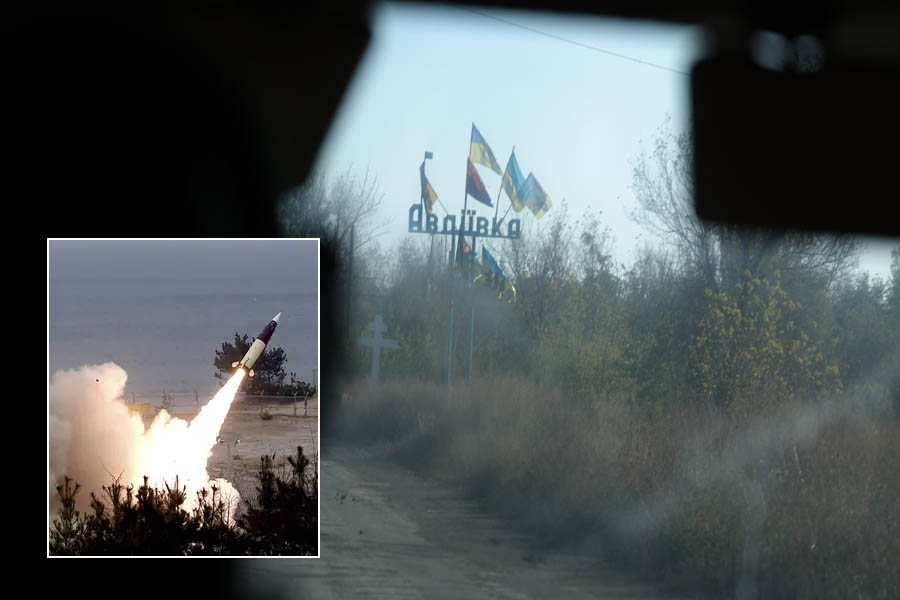
Ukraine Strikes Back: U.S.-Supplied ATACMS Missiles Turn the Tide in Ukrainian Counteroffensive — Precision Strikes Halt Russian Advances
In a groundbreaking turn of events, Ukraine has fired ATACMS (Army Tactical Missile System) missiles at Russian forces for the first time, marking a significant escalation in the conflict and a major boost to Ukraine's long-range strike capabilities. The missiles, secretly deployed by the United States in recent days, were utilized in a daring counteroffensive against Russian-held territories. This move comes after months of strategic planning and reflects the resilience of Ukraine's armed forces in the face of formidable challenges — and the Biden administration's willingness to finally provide weapons that had been withheld for fear of escalation.
The ATACMS missiles, part of the U.S.-supplied arsenal, were employed in a precision strike on two airbases near the temporarily occupied Luhansk and Berdyansk regions. Ukrainian President Volodymyr Zelensky confirmed the successful deployment, praising the accuracy and effectiveness of the missiles and extending his gratitude to the United States for their support. "The ATACMS have proven themselves," Zelensky said in his nightly address. "Our soldiers are using them precisely. They are hitting targets exactly where needed."
🎯 Precision Strikes: The Impact on Russian Air Power
The strikes targeted Russian military airfields, destroying multiple helicopters, ammunition depots, and runways. Ukrainian officials reported that nine Russian helicopters were destroyed or damaged in the attacks, along with air defense systems and other equipment. The strikes significantly degraded Russia's ability to provide close air support to its ground forces in the Zaporizhzhia and Donetsk sectors.
The decision to provide Ukraine with ATACMS missiles had been met with initial hesitance from the United States, fearing escalation and potential direct conflict with Russia. However, after careful consideration and reassurances from Ukraine that the missiles would not be used against targets inside Russian territory — only against occupied Ukrainian land, including Crimea — the Biden administration gave its approval. The missiles were delivered secretly, with Ukrainian crews trained in advance, to ensure operational surprise.
National Security Council spokesperson John Kirby confirmed the delivery, stating: "These missiles were provided to Ukraine to help them defend their sovereign territory. They have been used against legitimate military targets in occupied Ukraine, not inside Russia. That distinction is important."
⚔️ Ukrainian Counteroffensive: Adaptability and Resilience
The recent Ukrainian counteroffensive, particularly in the southern Zaporizhzhia region, has faced substantial challenges. Russian defensive lines — consisting of minefields, anti-tank obstacles, and well-fortified trenches — have slowed Ukrainian advances. Despite these difficulties, Ukrainian forces demonstrated adaptability and resilience, employing innovative tactics to respond to the evolving dynamics of the battlefield. The use of small group formations, supported by accurate firepower, allowed Ukrainian troops to advance incrementally, gaining ground against heavily entrenched Russian positions.
Ukrainian commanders have emphasized the importance of preserving soldiers' lives, avoiding the "human wave" tactics that have characterized Russia's offensives. "We are not in a hurry," said Colonel Dmytro Lysyuk, a Ukrainian brigade commander. "We will take our time. We will use our firepower to soften their defenses. And when the moment is right, we will strike."
The addition of ATACMS to Ukraine's arsenal has already changed the calculus. Russian logistics hubs, command centers, and airfields that were previously out of range of HIMARS GMLRS rockets are now vulnerable. Russian forces have begun moving their supply depots further from the front, increasing their logistical strain and slowing their ability to resupply front-line units.
🏙️ The Battle of Avdiivka: Russian Offensive Stalled
In contrast, Russia's large-scale offensive on the eastern Ukrainian town of Avdiivka faced fierce resistance from Ukrainian forces. The city, a key strategic point near the Russian-held city of Donetsk, has been under relentless bombardment by Russian artillery and airstrikes. Despite initial gains by Russian forces, Ukrainian resistance, bolstered by the deployment of ATACMS missiles, halted the advance, resulting in significant losses for the Russian military.
Russian forces launched what some analysts described as the largest armored assault of the war on Avdiivka, committing multiple brigades supported by artillery and aircraft. However, Ukrainian defenders — equipped with Javelin anti-tank missiles, artillery, and drone reconnaissance — repelled the attacks, destroying dozens of Russian tanks and armored vehicles. The burned-out hulks of Russian armor littered the fields around the city.
Ukrainian commanders like Colonel Dmytro Lysyuk emphasized the importance of balance in offensive operations, highlighting the need to preserve the lives of their soldiers. The adaptability and strategic acumen displayed by Ukrainian forces underscore their determination to defend their country against foreign aggression. "They came with everything they had," Lysyuk said of the Russian assault. "We stopped them. They did not take Avdiivka."
The defeat at Avdiivka represents a major setback for Russian military ambitions. Russian forces had hoped to encircle the city, a strategic victory that would have opened the door to further advances in Donetsk. Instead, they suffered heavy casualties and made only marginal gains.
🛡️ A Turning Point in the Conflict
The deployment and effective use of ATACMS missiles mark a turning point in the conflict, giving Ukraine a crucial advantage in targeting Russian military assets at long-range distances. Prior to ATACMS, Ukraine relied on HIMARS GMLRS rockets (70km range) and domestically-produced drones to strike behind Russian lines. ATACMS fills a critical gap in Ukraine's deep-strike capability, allowing it to target Russian command centers, ammunition depots, and airfields without risking Ukrainian aircraft.
Military analysts note that ATACMS will be particularly effective in Crimea, where Russian air defenses are concentrated but where long-range missiles can still penetrate. The strikes on Berdyansk and Luhansk airbases demonstrated that Russian air defenses — including the S-400 system — cannot reliably intercept ATACMS missiles, which fly on high, fast trajectories.
Russia has responded by relocating its air assets further east, reducing their effectiveness in supporting front-line operations. The Kremlin condemned the US decision to supply ATACMS, with Foreign Ministry spokeswoman Maria Zakharova calling it a "direct escalation" that would "not go unanswered." However, the Russian response has so far been limited to rhetorical threats.
🌟 The Road Ahead: What ATACMS Means for Ukraine
The introduction of ATACMS is not a silver bullet, but it is a significant force multiplier. Ukrainian forces will now be able to strike Russian targets throughout occupied Ukraine, including the Crimean Peninsula, which Russia has used as a staging ground for attacks on southern Ukraine. The Kerch Strait Bridge — a symbol of Russian occupation — is now within range, though Ukrainian officials have been careful not to confirm plans to strike it.
As the conflict continues to unfold, the world watches with bated breath, witnessing the unwavering courage and determination of the Ukrainian people in the face of adversity. The recent events serve as a testament to Ukraine's resilience and its commitment to defending its sovereignty and territorial integrity. The successful deployment of ATACMS has given Ukraine a new tool in its arsenal — one that could help turn the tide of the war.
However, challenges remain. Ukraine will need a steady supply of ATACMS missiles — currently, the US has provided only a limited number. Ukrainian forces must also be judicious in their use, saving the long-range missiles for high-value targets. The coming months will test whether Ukraine can capitalize on the momentum gained from the introduction of ATACMS and other Western weapons.
For the soldiers on the front lines, the arrival of ATACMS is a morale boost. "Now we can hit them where it hurts," one Ukrainian soldier told Reuters. "We have been waiting for this for a long time. It's not the end of the war, but it's a new beginning."
Related Coverage: For more on ATACMS and US military aid, visit U.S. Contemplates Supplying Ukraine with Critical ATACMS Missiles and Russia-Ukraine War: Recent Escalations Analysis.
Global Post Headline — independent coverage of the Russia-Ukraine war. globalpostheadline.com | Follow updates: War News | US News

Experience the Himalayas with expert Sherpa guides. Trekking, expeditions, and cultural tours in Nepal, Tibet & Bhutan.
Plan Your Nepal Trip →
Authentic Nepali crafts, pashmina, singing bowls — worldwide shipping.