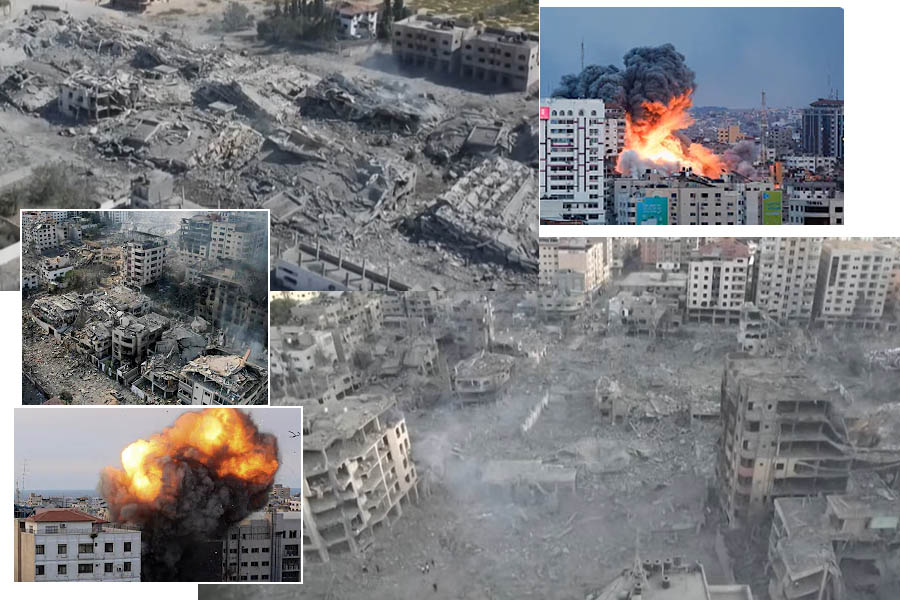
Israeli Military Expands Road in Gaza, Signaling Long-Term Control Strategy — The Netzarim Corridor
As tensions persist in the Gaza Strip, the Israeli military is undertaking significant infrastructural developments, including the expansion of a crucial road network. This endeavor, aimed at enhancing military operations and asserting control over the region, underscores Israel's commitment to maintaining security amid ongoing conflict. The gravel-paved road, spanning central Gaza, serves as a strategic corridor for Israeli forces, facilitating swift movement across the enclave. This initiative forms part of a broader strategy to reshape Gaza's topography, bolstering Israel's grip on territory that has been a focal point of recent hostilities.
The Netzarim Corridor: A Strategic Divide
Stretching approximately 5 miles (8 km) from the Israeli border to the Mediterranean coast, the road — known as the Netzarim Corridor — divides Gaza into distinct northern and southern sectors, allowing for enhanced military maneuverability. With plans to withdraw troops from populated areas, Israel aims to concentrate on targeted raids against Hamas, the militant group responsible for recent attacks. The corridor effectively cuts off Gaza City from the south, making it easier for Israeli forces to prevent Hamas fighters from moving between the two halves of the Strip. In conjunction with the road expansion, the Israeli military is establishing a buffer zone along Gaza's border with Israel, restricting Palestinian entry to an area that will be cleared of civilian structures.
US Concerns and Israeli Determination
Despite warnings from U.S. officials against altering Gaza's borders, Israel remains steadfast in its commitment to maintaining security control over the territory. The Biden administration has expressed concern that such infrastructure projects could preclude a two-state solution and effectively create permanent Israeli occupation. However, Israeli authorities assert that the road project is a temporary measure, intended to support ongoing military operations. However, analysts suggest that its implementation could have lasting implications, effectively creating a militarized barrier across Gaza. The road is being constructed with gravel and dirt, but satellite imagery shows it is being widened and reinforced, suggesting a durable military installation rather than a temporary wartime measure.
Impact on Displaced Gazans
Furthermore, the revamped road may hinder the return of displaced Gazans, who fled southward during intense bombardments earlier in the conflict. Guarded by Israeli troops to deter militant attacks, the corridor symbolizes Israel's determination to assert dominance over the region. Over 1.4 million Palestinians are currently sheltering in Rafah and other southern areas, and the road's presence complicates any potential return to northern Gaza, where much of the housing stock has been destroyed. Human rights groups have warned that the corridor could become a permanent checkpoint system, limiting freedom of movement for Palestinians in any post-conflict arrangement.
'Long-Term Temporary' Strategy
According to Miri Eisin, a retired colonel in the Israeli Army, the utilization of the east-west corridor is envisioned as a "long-term temporary" solution, with plans for continued military presence throughout 2024 and potentially beyond. Combat engineers are actively widening the road and demolishing structures along its flanks to enhance its military utility. The road is being fortified with concrete barriers and surveillance equipment, indicating Israel's intention to maintain operational control over the corridor for the foreseeable future, regardless of whether a ceasefire is reached.
Satellite Imagery Reveals Transformation
Satellite imagery reveals the transformation of Gaza's landscape, with the road cutting through farmland and sparsely populated areas. Images from Planet Labs show the corridor as a clear line across the center of the Strip, with dozens of demolished buildings along its path. Jacob Nagel, a former Israeli national security adviser, suggests that the road serves to demarcate northern Gaza from the rest of the enclave, albeit symbolically. However, military analysts note that the corridor provides the IDF with a logistical backbone for sustained operations, enabling rapid resupply and reinforcement of forces on both sides of the divide.
Shift to Targeted Raids
As Israel transitions to targeted raids in northern Gaza — shifting from large-scale ground maneuvers to more precise, intelligence-driven operations — the road project signifies a strategic shift in military operations. Despite ongoing challenges, including the presence of thousands of civilians in Gaza City, Israel remains resolute in its commitment to security and stability in the region. The corridor allows Israeli forces to launch raids into Gaza City from a secure base of operations and then return, rather than maintaining a continuous occupation of urban areas — a strategy designed to reduce IDF casualties while maintaining pressure on Hamas.
Geopolitical Implications
The expansion of the road network in Gaza epitomizes Israel's proactive approach to safeguarding its interests amid a complex and volatile geopolitical landscape. While the long-term implications of these developments remain uncertain, they underscore the enduring tensions and strategic imperatives shaping the Israeli-Palestinian conflict. Some analysts view the corridor as a precursor to a permanent Israeli security presence in Gaza after the war, potentially including a re-established buffer zone and control over movement between north and south. The road project will likely be a major point of contention in any post-war negotiations over Gaza's governance.
Related Coverage: For ongoing updates on the Gaza war and Israeli military strategy, visit our Middle East Breaking News page and Israel-Gaza War Hub.
Global Post Headline — independent Middle East coverage. globalpostheadline.com | Follow live: middle-east-breaking.php