German Air Force Officers' Ukraine Support Discussions Trigger Investigation — Scholz Confirms Authenticity of Leaked Taurus Missile Recording Amid Russian Espionage Fears
Berlin — March 2, 2024 — Germany's Chancellor Olaf Scholz has initiated an urgent investigation following the publication of a 38-minute audio recording in Russia that purportedly captures senior German Air Force (Luftwaffe) officers discussing sensitive military support for Ukraine, including the potential delivery of Taurus long-range cruise missiles and specific targeting considerations — including the Kerch Strait Bridge connecting Crimea to the Russian mainland. The leak, which German officials have confirmed as authentic, represents one of the most significant intelligence breaches in recent German history and has sparked serious concerns about Russian espionage operations within NATO's second-largest military.
The recording, first published by Margarita Simonyan, the head of Russia's state-backed RT channel, appears to capture a WebEx conference call among what German media has confirmed as senior Luftwaffe officers. The discussion details the technical capabilities of Taurus missiles, including their 500-kilometer range, bunker-busting warheads, and the targeting process. Most embarrassingly for Berlin, the officers are heard deliberating about how Ukraine could use the missiles to strike the Kerch Bridge — a symbol of Russian occupation of Crimea — without direct German involvement, essentially discussing ways to circumvent Scholz's stated red lines.
- 🎙️ 38-minute WebEx call among senior Luftwaffe officers (March 2024)
- 💬 Discussion of Taurus missile delivery to Ukraine and training requirements
- 🌉 Detailed analysis of targeting the Kerch Strait Bridge (Crimea-Russia link)
- ⚙️ Technical specifications of Taurus — range, warhead, guidance systems
- 🔍 How Ukraine could use missiles without direct German involvement
🎙️ The Leak: Authenticity Confirmed, Security Protocol Questions
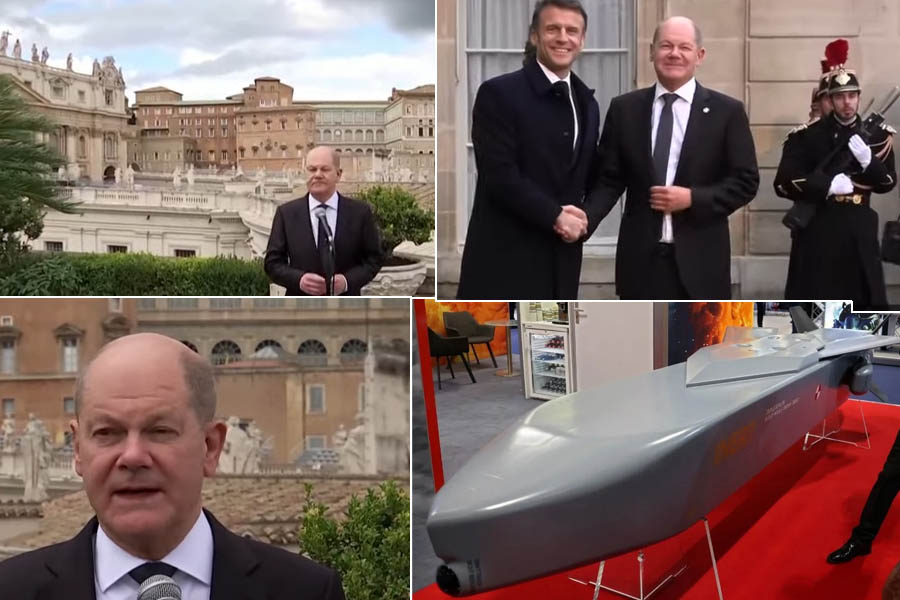
During a visit to the Vatican, Chancellor Scholz acknowledged the gravity of the situation, confirming that the German government was taking the leak "very seriously" and would provide full clarity on the matter. However, his earlier statements from the Vatican also reaffirmed his longstanding reluctance to send Taurus missiles to Ukraine — a position that has frustrated Kyiv and some NATO allies but reflects fears of direct German involvement in the war and potential escalation with Russia.
The German press has since reported that the discussions were verified as formal exchanges between military officers, but they were conducted via the WebEx platform — a commercial, non-classified video conferencing tool — rather than a secure internal military network (such as the German Armed Forces' classified system). This choice of platform may explain the vulnerability to interception by Russian intelligence services. According to Bild newspaper, one of the participants dialed in from a hotel room in Singapore using an unsecured line, significantly increasing the risk of eavesdropping.
Defense Minister Boris Pistorius has called the leak "a hybrid disinformation attack" by Russia, but he has not denied the authenticity of the recording. "Parts of the conversation were intercepted and manipulated in the way it was disseminated," Pistorius said, "but the core discussion did take place. This is a wake-up call for our communication security."
- 🔒 How did Russian intelligence intercept a supposedly secure military conversation?
- 📱 Why were senior officers using commercial WebEx instead of classified networks?
- 🛡️ Is Germany's military communication infrastructure vulnerable to espionage?
- ⚖️ What disciplinary action will be taken against the officers involved?
- 📡 Could other sensitive discussions have been intercepted?
🚀 Taurus Missiles: A Red Line for Scholz
The leaked discussion has resurfaced the contentious debate over Taurus missile deliveries to Ukraine. The Taurus KEPD 350 is a German-Swedish air-launched cruise missile with a range of over 500 kilometers and a 480-kilogram dual-stage warhead capable of penetrating reinforced concrete bunkers. It is widely considered the most capable weapon in Germany's arsenal that has not yet been supplied to Ukraine — comparable to the British Storm Shadow and French SCALP-EG already in Ukrainian service.
Scholz has repeatedly refused to supply Taurus missiles, citing two primary concerns: first, that German military personnel would need to be involved in targeting (a "direct participation in the war" red line), and second, that the missiles could reach Russian territory, risking escalation. However, the leaked recording shows Luftwaffe officers discussing ways that Ukraine could use Taurus without direct German involvement — contradicting Scholz's public rationale.
"The officers were essentially brainstorming how to work around the Chancellor's red lines," said former NATO official James Appathurai. "That's not a security breach — that's a political embarrassment. It shows that even Germany's own military believes the Taurus could be delivered without crossing the threshold that Scholz has articulated."
🕵️ Russian Espionage: A Deliberate Expose
The publication of the recording by Margarita Simonyan — a prominent Russian propagandist and close ally of President Vladimir Putin — suggests a deliberate intelligence operation aimed at embarrassing Germany and undermining Western unity on Ukraine support. By releasing the audio less than a week before a scheduled meeting between Scholz and Ukrainian President Volodymyr Zelenskyy, Russian intelligence appears to have intended to sow discord and expose divisions within NATO.
"This is classic Russian hybrid warfare," said Ben Hodges, former commander of US Army Europe. "They want to show that German officials are debating the war, that they're divided, and that they're even discussing targeting Russian infrastructure. It's designed to chill support for Ukraine and intimidate European publics."
German counter-intelligence officials (MAD) are now investigating how the recording was obtained. Initial theories include: a compromised participant (either by malware or human intelligence), interception of the WebEx transmission via man-in-the-middle attack, or physical bugging of the location where the call took place. The investigation will also examine whether any classified materials were accessed or exfiltrated by Russian operatives in the lead-up to the leak.
FRANCE 24's former Moscow correspondent Nick Holdsworth noted that the leak serves multiple Russian objectives: "It discredits the German government, casts doubt on Scholz's leadership, and provides Russian propaganda with concrete 'proof' that NATO is actively planning strikes on Crimea. It's a win-win for the Kremlin, regardless of whether the content is embarrassing or not."
🌍 Diplomatic Fallout: Germany-Russia Tensions Escalate
The revelation has prompted immediate diplomatic tensions. Russian Foreign Ministry spokeswoman Maria Zakharova has demanded "explanations from the German government" about the discussions, accusing Germany of "planning attacks on Russian sovereign territory." Moscow has also summoned the German ambassador for a formal protest, escalating the confrontation.
German officials have rejected Russia's demands as "absurd" given that Russia is the aggressor in the war, but they acknowledge that the leak has handed Moscow a propaganda victory. "Russia invaded Ukraine illegally," Scholz said. "The fact that we are discussing how to help Ukraine defend itself is not a scandal — it's our duty. But the leak itself is unacceptable, and we will take all necessary measures to prevent future breaches."
NATO Secretary General Jens Stoltenberg expressed confidence in Germany's ability to manage the fallout, but European security officials privately acknowledge that the leak has damaged trust in Germany's operational security. Allies may become more reluctant to share sensitive information with Berlin until the source of the breach is identified and closed.
- ⚠️ Trust erosion — Allies may limit intel sharing with Germany
- 📋 Operational review — All European militaries re-examining communication security
- 🎯 Propaganda victory — Russia weaponizes leak for domestic and international audiences
- 🔮 Taurus decision — Leak may harden Scholz's refusal (or force reversal?)
📊 What Comes Next: Investigations, Political Fallout, and Military Reforms
Germany's military counter-intelligence service (MAD) has launched a full investigation, with the following priorities: (1) identifying how the intercept occurred, (2) determining whether any other sensitive conversations were compromised, (3) assessing disciplinary action against the officers involved for using insecure communications, and (4) recommending reforms to prevent future breaches.
Political fallout is already unfolding. Opposition parties, including the Christian Democratic Union (CDU), have called for a parliamentary inquiry into the leak and into Scholz's broader Taurus policy. "The Chancellor says he cannot deliver Taurus because of German involvement concerns," said CDU defense spokesman Roderich Kiesewetter, "but his own military officers were discussing exactly how to avoid that involvement. The contradiction is glaring."
For Ukraine, the leak is a double-edged sword. On one hand, it confirms that German military planners are actively considering Taurus deliveries and have identified viable targeting strategies. On the other hand, the resulting political firestorm may make Scholz even more reluctant to approve a transfer, fearing accusations of bowing to Russian pressure.
As Germany grapples with the fallout from this leak, questions linger about the future of its diplomatic approach, its commitment to supporting Ukraine's defense efforts against Russian aggression, and the security of its military communications in an era of sophisticated Russian cyber and intelligence operations. The investigation will be closely watched by allies and adversaries alike, as its findings could reshape European security protocols for years to come.
Original Reporting: This analysis was first published on 2 March 2024. Continuous coverage at Global Post Headline Ukraine War Desk.
Global Post Headline — independent coverage of European security and intelligence issues. globalpostheadline.com | Follow: Ukraine War Desk | Europe Desk


Authentic Nepali handicrafts, pashmina, singing bowls.