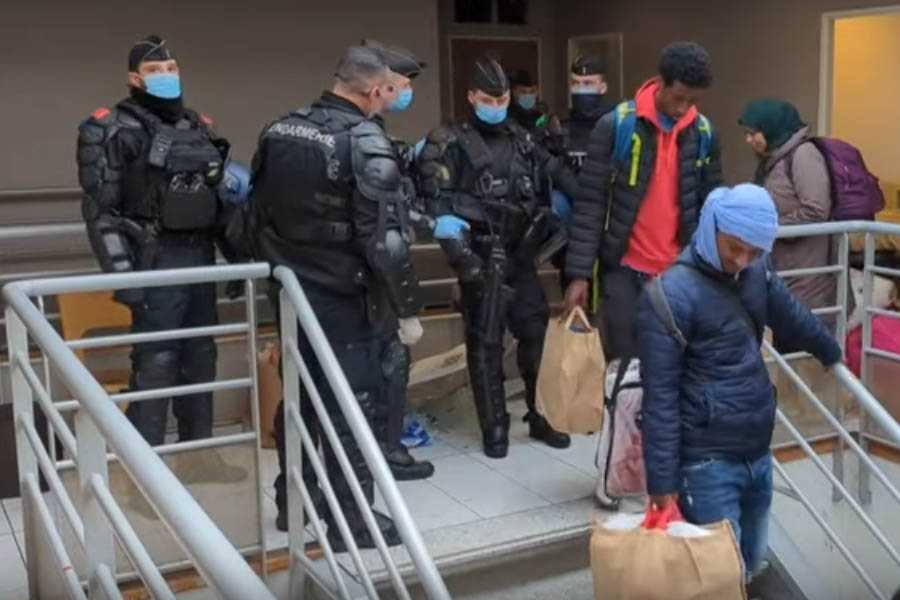
France: Police Clear Largest Migrant Settlement Ahead of Paris Olympics — 450 People Evicted as 'Social Cleansing' Accusations Fly 100 Days Before Games
Vitry-sur-Seine, France — April 18, 2024 — In a dramatic prelude to the much-anticipated Paris Olympics, French authorities have forcibly evicted approximately 450 migrants from an abandoned office building in a Paris suburb, in an operation that migrant aid groups have condemned as "social cleansing" ahead of the global sporting event. The raid, which took place Wednesday in Vitry-sur-Seine, just 5 kilometers southeast of central Paris, has intensified scrutiny of France's treatment of vulnerable populations as the nation prepares to welcome millions of visitors for the 2024 Summer Games.
The abandoned three-storey office building had served as the largest migrant settlement in the Paris region, with approximately 450 individuals — including 50 women and 20 children — taking refuge there over the past three years. The building, which lacked running water, electricity, and sanitation facilities, became a de facto shelter for migrants primarily from sub-Saharan Africa, many of whom had been waiting years for asylum decisions.
- 👮 250 police officers executed the operation at dawn
- 🚪 Officers forcibly broke open doors and directed occupants onto waiting buses
- 🚌 Migrants transported to locations across France: Pays de la Loire, Orleans, Bordeaux
- ⚠️ Several days of warnings preceded the evacuation
- 📋 Aid groups say no long-term housing plan was provided
🏛️ 'Social Cleansing' Accusations: Aid Groups Speak Out
Migrant aid organizations have reacted with outrage, characterizing the eviction as a form of "social cleansing" designed to remove visible poverty and migrant populations from the capital's periphery in time for the Olympics. The timing — exactly 100 days before the opening ceremony — has prompted particular scrutiny, echoing patterns seen in previous host cities including Rio de Janeiro (2016), Sochi (2014), and Beijing (2008).
"This is not about safety — it's about image," said Clarisse Boyer of the migrant support group Utopia 56. "The government wants Paris to look beautiful for the world's cameras, and that means hiding the homeless and the migrant families who have made their homes here. These people have been living in this building for three years. Now, just before the world arrives, they are shipped off to distant cities with no support and no plan."
Interior Ministry officials defended the operation, citing health and safety concerns as well as the need to prepare the area for Olympic-related infrastructure. "The building was insalubrious and dangerous for its occupants," a ministry spokesperson said. "We have offered alternative accommodation to all those evacuated. France respects its humanitarian obligations."
Critics note, however, that the alternative accommodations are temporary — typically 3 to 6 weeks in emergency shelters — after which migrants are left to fend for themselves in unfamiliar cities far from legal aid services and community networks.
⚔️ Olympic Security: The Threat Landscape
The migrant eviction comes amid heightened security preparations for the Paris Olympics, which are scheduled to run from July 26 to August 11, 2024, followed by the Paralympics from August 28 to September 8. President Emmanuel Macron has acknowledged significant security risks, including the threat of terrorism. France has been on its highest terror alert level since a fatal stabbing in Arras in October 2023, and ISIS has issued multiple threats against European sporting events in recent months.
In March 2024, a suspected ISIS-K operative was arrested in Paris on charges of planning an attack during the Olympics. French intelligence officials have warned of the possibility of lone-wolf attacks, cyberattacks, and drone incidents. The government has raised the threat level to the maximum "attack emergency" designation, only the third time since 2017 that this level has been activated.
Macron has indicated that contingency plans are in place for the Olympics' opening ceremony — an unprecedented event scheduled to take place on the Seine River, with athletes parading by boat in front of an expected 600,000 spectators along the riverbanks. However, concerns about security have led to speculation that the ceremony may be scaled down or relocated from its planned riverside location.
- 🚔 35,000+ police and gendarmes deployed daily
- 🛡️ 10,000+ military personnel for counter-terrorism
- 🛂 1,000+ cyberattack specialists monitoring threats
- 🎭 600,000 expected spectators at Seine opening ceremony (if held)
- ✈️ No-fly zone over Paris during Games
📅 The Opening Ceremony: Ambition Meets Reality
The opening ceremony of the Paris Olympics, scheduled for July 26, is slated to be the most ambitious in Olympic history. For the first time, the ceremony will not be held in a stadium but instead will unfold along a 6-kilometer stretch of the Seine River, with athletes paraded on boats past iconic landmarks including Notre-Dame Cathedral, the Louvre, and the Eiffel Tower.
However, the security challenge is immense. Protecting a moving river procession with thousands of spectators lining both banks is exponentially more difficult than securing a confined stadium. French authorities have been practicing for years, but the sheer number of variables — boat traffic, bridges, riverside buildings, and underground tunnels — has led to multiple scaled-back versions of the plan.
Macron has publicly stated that he has "Plan B" and "Plan C" contingencies, including relocating the ceremony to the Stade de France or the Trocadéro if the threat level requires. A final decision is expected in early June, based on real-time intelligence assessments.
"We are preparing for all scenarios," Macron said in a recent interview. "The Games must be a celebration of unity and peace, but they must also be safe. We will not take unnecessary risks."
🏠 Migrant Displacement: A Broader Pattern
The Vitry-sur-Seine eviction is not an isolated incident. Since France was awarded the Olympics in 2017, authorities have systematically cleared migrant camps in and around Paris. In the past 12 months alone, more than 1,500 migrants have been relocated from the capital region to other parts of France, according to aid group data.
Human rights organizations have documented similar patterns in previous Olympic host cities. A 2020 report by Amnesty International found that Rio de Janeiro forcibly removed 77,000 people — disproportionately poor and non-white — in the lead-up to the 2016 Games. London, Sochi, and Beijing saw similar displacements. The phenomenon has been termed "Olympic evictions" or "Games-related gentrification."
French authorities reject the "social cleansing" label, arguing that the evictions are standard urban planning and that relocated migrants receive housing assistance. They also point to France's record of asylum acceptance — 30% of applicants receive protection, higher than many European neighbors — as evidence of humanitarian commitment.
Nevertheless, the optics of police forcibly removing families from a building just months before the world's cameras arrive are difficult to ignore. UN experts have called on France to ensure that security preparations do not violate human rights obligations, including the right to adequate housing and protection from arbitrary displacement.
🌍 The Global Stage: France's Dual Challenge
As France gears up to host the Olympics, the government faces the dual challenge of ensuring the safety of participants and spectators while upholding humanitarian principles. The eviction in Vitry-sur-Seine highlights the tension between these objectives: security requires clearing potentially vulnerable or unmonitored sites, but the manner of clearing raises ethical and legal questions.
International observers will be watching closely. The Paris Olympics are expected to attract 15 million visitors and generate €10 billion in economic impact. But the Games will also shine a spotlight on France's social policies, its treatment of migrants, and its security apparatus. The legacy of the 2024 Olympics will be defined not only by athletic achievements but by how the nation treated its most vulnerable residents in the lead-up to the world's biggest celebration.
For the 450 migrants displaced from Vitry-sur-Seine, the future remains uncertain. Buses carried them to unfamiliar cities where they have no community, no legal support, and no long-term housing. Some will return to Paris. Others will try to restart their asylum claims elsewhere. Many will disappear into informal settlements, their hopes of finding safety in France fading.
"We are not criminals," one evicted migrant told reporters. "We are people who fled war, who fled persecution. We just wanted a chance. Now, we are being pushed away because some people want a pretty picture for television. Is that what France stands for?"
Original Reporting: This analysis was first published on 18 April 2024. Continuous coverage at Global Post Headline Europe Desk.
Global Post Headline — independent coverage of European migration and human rights. globalpostheadline.com | Follow: Europe Desk | Olympics 2024


Authentic Nepali handicrafts, pashmina, singing bowls.